Try this: Choose two familiar actions, say them in a clear order, and ask the child to tell or show the plan before beginning.
Keep the first example easy
A two-step direction asks a child to hold two actions in mind. The words, materials, and actions all affect how demanding that feels. Begin with things the learner already knows and put the materials within reach.
For a first attempt, place a pencil and paper on the table. Say, “Draw a circle, then put your pencil beside the paper.” You are checking the two actions and their order, rather than how carefully the circle is drawn. Give the child time to process before adding more language.
Show what remembering can look like
Model the routine once: “I have two jobs. First, draw a circle. Then, put the pencil beside the paper.” Hold up a finger for each action if that helps. Do both actions, then look back at the plan together.
Adult: “Draw a circle, then put your pencil beside the paper. What will you do first?”
Possible answer: “Draw a circle.”
Adult: “What comes after that?”
Possible answer: “Put my pencil down beside the paper.”
Let children rehearse aloud, point to two picture cues, or quietly repeat the plan. The rehearsal is support for remembering. It does not have to become a test in itself.
Three prompts to use today
- A drawing prompt: “Draw a square, then put one dot inside it.” Expected result: a square containing one dot.
- A table routine: “Close the book, then put it beside the pencil.” Expected result: the book is closed before it is moved.
- A home routine: “Put the crayons in the box, then bring the box to the table.” Use a familiar, reachable table and a manageable box.
Choose the prompt that fits the child's vocabulary and surroundings. Words such as beside or inside may need their own demonstration. When teaching a new position word, keep the rest of the direction simple.
When only the first step happens
Pause and ask, “What was our other job?” If the child cannot recall it, show the two cues or repeat the full direction calmly. Then let them try again. One missed step does not tell you why it was missed: the vocabulary, attention, memory demands, or the environment may all matter.
For more support, practice each action separately before combining them. For a greater challenge, change one action while keeping the structure familiar. Add a third step only when two steps are manageable with the supports your learner uses.
Finish by checking the plan
Ask, “Did we do both jobs?” Let the child point to the drawing or materials as evidence. Eventually they can give you two directions and check your response. Make a small, obvious mistake and invite them to explain what to fix.
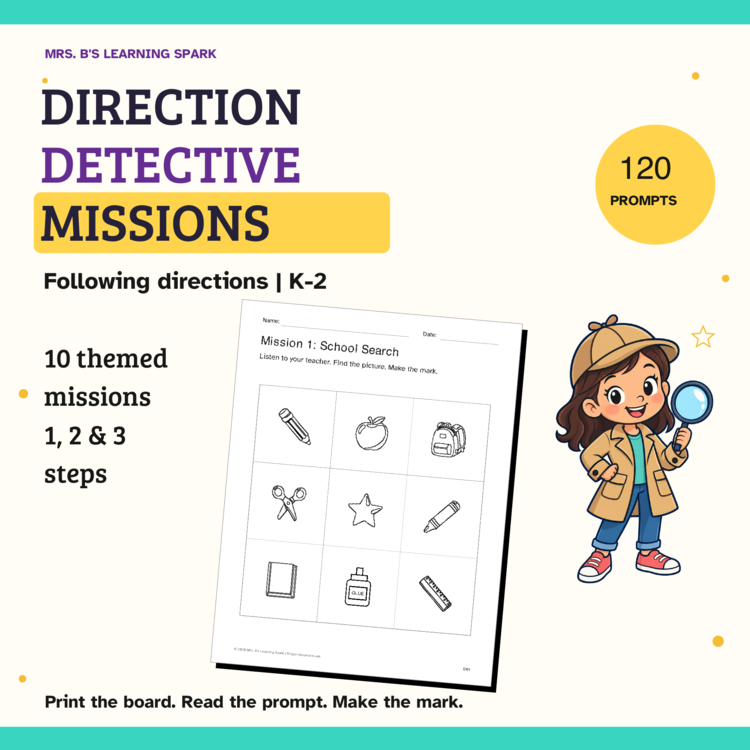
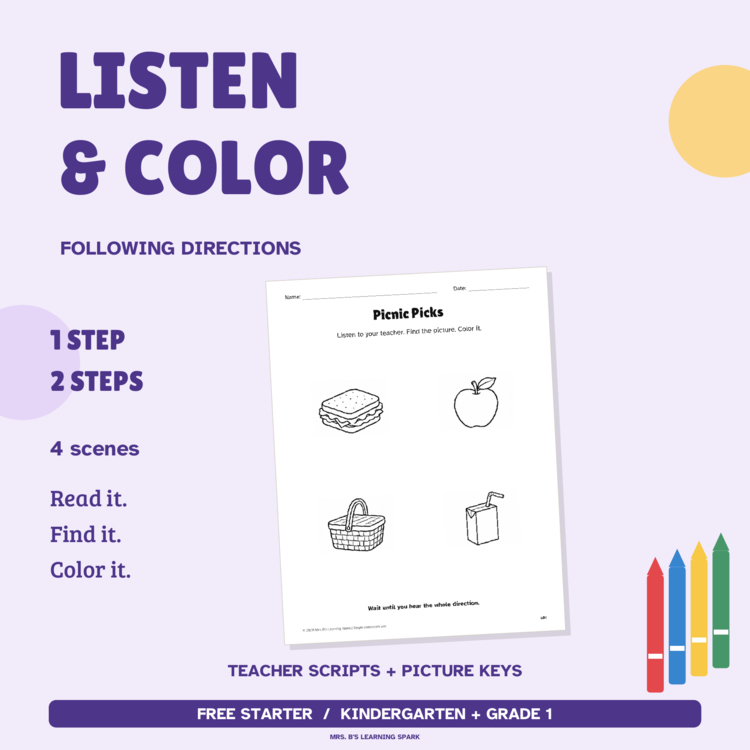
For ready-made practice, try the free listen-and-color activities, or explore Direction Detective for one-, two-, and three-step worksheets. Read the prompts aloud when reading is not the skill you are checking.